
Read our blog yet?
2026 update: A&O / CDS is pleased to make a version of RECIST360 available to the oncology community as a free online educational resource and RECIST calculator. Developed in 2018 and supporting lesion and response data oversight since 2020, RECIST360 reflects our continued commitment to advancing more efficient, transparent and consistent oncology data review. While our recent focus has been on vendor reconciliation, we believe this earlier innovation remains highly relevant and valuable to the wider oncology community. As one of the most complex areas of clinical data management, oncology data review can benefit from practical, innovative tools that support clearer oversight, earlier issue identification and more efficient review. We invite you to explore RECIST360 for yourself here.
Background
Assessment of lesion data is often time-consuming and in many instances is not performed in a methodical fashion, despite the emergence of guidance such as RECIST 1.1. These 'rules', whilst providing a common framework across studies, still leaves the review of the lesion data itself performed inefficiently. EDC platforms only have a limited number of edit checks and any programmed listings are very manual and complex in nature, usually requiring the end user to already have an established background in the oncology therapeutic area. This can result in both data management and medical review being performed late and only after a study has matured, with the task itself in flat files laid out incoherently. Indeed, this remains in stark contrast to an intuitive, fast and continuous oversight framework or tool, as expected with RBQM/ICH E6 (R3) best practices.
RECIST360 has been programmed to enable multi-disciplinary review of lesion data. Thanks to its speed and automation, such review can be cyclical and frequent in nature. It’s multi-disciplinary because RECIST 1.1 is a framework by definition that can be translated into logical coding, meaning that data management can utilise a tool without the need of medical interpretation (because – again – these are sets of rules), whilst study physicians, alike, can work from the same system. The combination of a visual timeline view, accompanied with humanised text-based 'findings', enables a reviewer of any background or any level of oncology experience to quickly establish where the issues exist. Indeed, dependency on oncology-specific resourcing needs is much reduced, potentially creating fluidity in personnel and resourcing across departments.
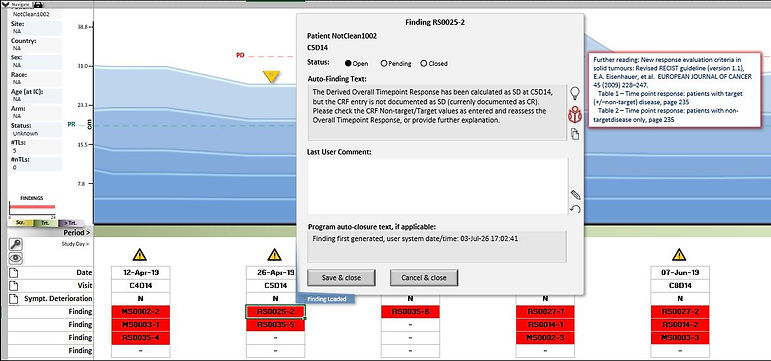
Figure 1: the timeline view with a loaded programmed data finding.
RECIST360 features:
-
Ready-to-go: EDC / SDTM data upload, with no re-programming of the tool itself required
-
Edit checks (i.e., the ‘Findings’) can be turned on/off, if required
-
No double data review of the same data following merging with fresh data (all data review comments are maintained and ‘Findings’ will simply close/open as a result of data changes)
-
Findings are easily reviewed and either result in a closure or are followed up via a query (raised in the study EDC system for full ICH/GCP compliance)
Examples of best use:
But first, a reminder: The data that contributes to RECIST 1.1 is very special. Whilst not generally labelled as ‘safety data’, it is exactly this: when RECIST 1.1 criteria is applied to collected data, it helps define a patient’s treatment plan in collaboration with their treating physician. With data of this importance, it is imperative checks and balances are in place at ALL stages of the data’s lifecycle. Such in-field treatment plan decisions are derived from scans and measurements, whether manually compiled or automatic in nature (e.g., AI systems with human oversight). And this happens prior to EDC data entry. It’s only when data is entered into EDC - or similar system - that RECIST360 has the potential for sponsor/CRO use. Therefore the RECIST360 tool is NOT a ‘front-end’, clinical, in-field solution, but rather what is known as a ‘backend’ oversight tool. With this in mind, here are some practical uses:
-
ensures EDC data entry is correct very soon post-entry
-
escalate noticed discrepancies earlier (there’s always the potential sites have made an ‘in-field’ error)
-
run the program over mature studies for historical inaccuracies and potential data correction/protocol violation capture prior to lock
-
run the program over multiple, locked, studies to assess historical inaccuracies to contribute to future site selection evaluations
-
as a sponsor, run the program over multiple studies to assess CRO performance issues and demonstrate CRO oversight occurred
Your studies should already have a degree of lesion and response programmed oversight, but an extra layer may help uncover isolated (or systemic!) failings. As mentioned, RECIST360 maintains data review comments and the status of findings between refreshes. However, whilst the technology behind RECIST360 itself is not CFR-21 Part 11 compliant, validation can always be documented on real world/dummy scenarios and, in any event, CFR-21 Part 11 compliant systems must always be consulted and used when resolving data discrepancies for full auditability (chiefly, queries in the EDC application). The use of this tool and the speed and automation it brings to both data review and oversight of existing processes will only help you demonstrate risk-based quality management was well established on your studies.
How do clients get started?
RECIST360 is proprietary software designed to deliver value through more efficient oversight, cost savings and earlier identification of potential issues. To protect the integrity of the solution, we provide RECIST360 through a consultancy-led model rather than releasing the underlying tool directly to clients. This enables us to bring the solution to you while ensuring that its creators remain closely involved, providing expert support and reducing the need for extensive client-side training. With this in mind, the following approach may be helpful.
-
We suggest trying the online educational facility, because it provides a chance for a demonstration in your own free time, free of charge, with no personal details or data exchanged. From it, not only will you see this tool is a reality, but it can also help avoid unnecessary, costly and time-consuming demonstration meetings (try it here)
-
Alternatively – should your raw data or SDTM data differ significantly to that of the online facility – your own dummy data can be sent to info@apples-and-oranges.co.uk and we can return example outputs at our earliest convenience
-
After your own and (as you can see) non-pressured and well evidenced evaluation of this solution is made, we suggest you take this discussion further into your team and relevant stakeholders.
In practice this means we can provide documentation of validation against your own data structures (realworld/dummy), will provide continuous .xlsx outputs upon each refresh for documentation and proof of regular oversight, all for filing per your own internal practices. However – and to emphasise - the wider team needs to be aware the coding of the tool itself is never released to a client.
Should you still be happy to engage in a meeting to further understand your requirements and iron out other questions and logistics, please do not hesitate to contact us.
With all that explained, we hope you appreciate how simple this is to make your own informed decision as to whether we are a good solution for your need. Finally, availability of the solution will be guided by the level of interest it receives. If you believe RECIST360 may be relevant to others in your network, we would welcome your support in sharing this Linkedin post, commenting, reposting it, or tagging colleagues who may benefit from learning more.
::RECIST360:: Patient lesion timeline and data cleaning presentation


Feedback
If you have any questions or comments about this tool, please enter them below.